
Setup · 6 min
Claude Pro vs Max: the actual math for Claude Code
Claude Pro is $20 a month. Max is $100 or $200. Every tier runs the same models, so the comparison pages mostly tell you what you already suspected: the bigger number buys more. This is the version with actual arithmetic in it — what a flat rate protects you from, which tier matches how many hours you build, and the one signal that tells you to move up.
Two ways to pay, one budget question
Claude Code requires a paid account — the docs are direct about it: Pro, Max, Team, Enterprise, or a Console (API) account. The free claude.ai plan doesn't include it. So the real question isn't whether to pay, it's which shape of paying fits how you build.
There are two shapes. A subscription (Pro or Max) is a flat monthly price for a usage allowance. The API is pay-as-you-go: as of June 2026, Claude Opus 4.8 costs $5 per million input tokens and $25 per million output. Run the arithmetic on that second shape: a session that reads five million tokens of project context costs $25 before Claude writes a single line back. Whether your sessions consume one million tokens or twenty depends on the work — which is exactly the problem. You can't put a moving meter in a budget.
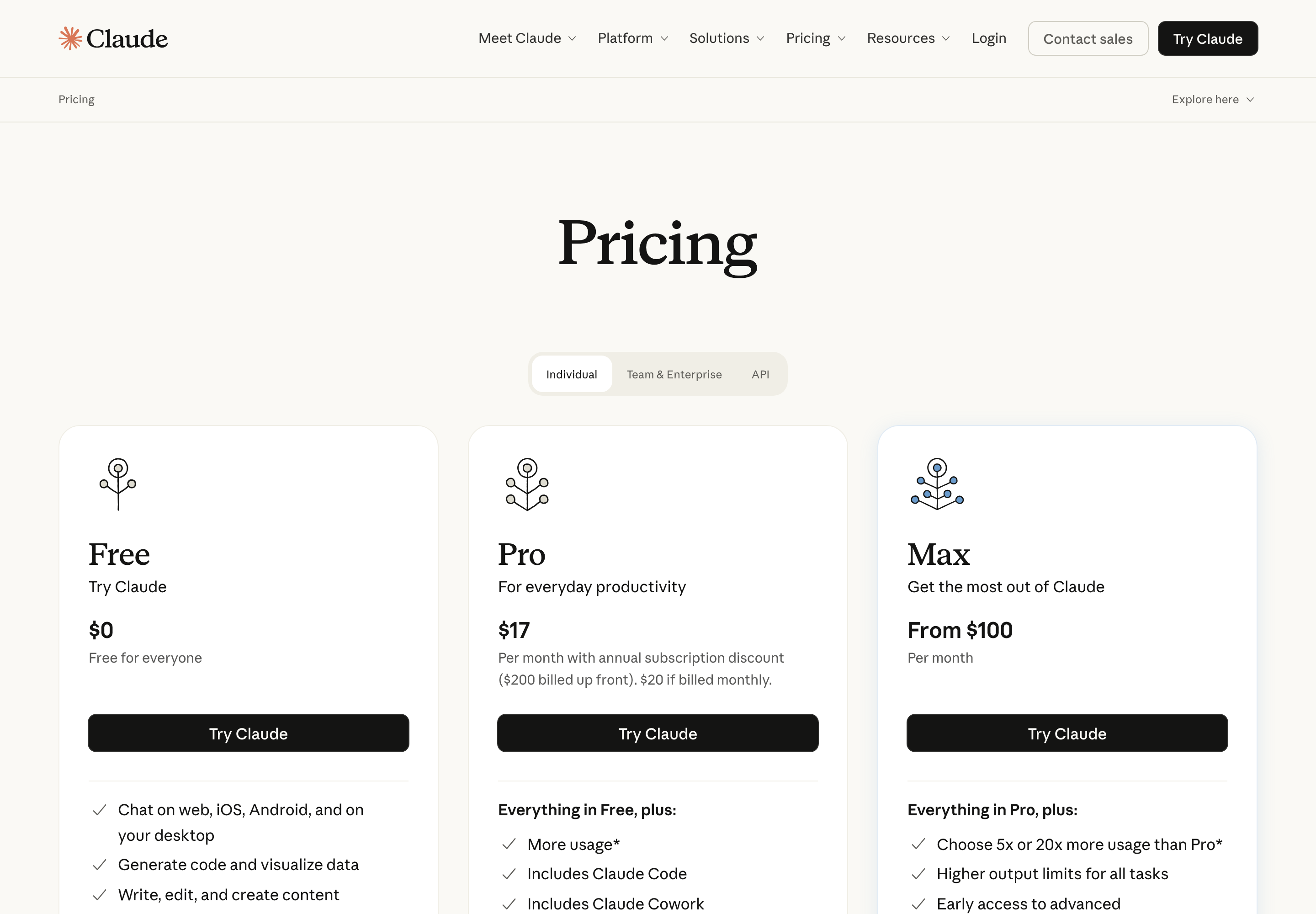
Read the middle card closely: Pro is $20/month, or $17/month if you pay $200 up front for the year — and "Includes Claude Code" is printed right on it. The Max card splits into two tiers when you pick it: Max 5x at $100/month and Max 20x at $200/month, the multipliers meaning five and twenty times more usage per session than Pro.
The decision table, by hours of building
| How you build | Tier | Price (June 2026) |
|---|---|---|
| Evenings and weekends, learning | Pro | $20/mo ($17/mo billed annually) |
| Most days, a few hours of real building | Max 5x | $100/mo |
| Claude running most of the day | Max 20x | $200/mo |
| Cloud deploys, CI, apps that call Claude | API key, metered | $5 in / $25 out per MTok (Opus 4.8) |
The last row matters even though it's the wrong default for daily building: the API has a real job. When you ship products that call Claude on a server, those bill per token with an API key. Your own day-to-day building stays on the subscription. Same models, two billing shapes, different jobs.
What the bigger number actually buys
Every paid tier gets the same models and the same Claude Code. What you're buying with a bigger number is headroom, measured two ways. Usage accrues in five-hour sessions, and your plan also carries weekly limits that reset at a fixed time assigned to your account. Both pools are shared across every surface — claude.ai chat, the desktop app, and Claude Code all draw from one allowance.
That design is why the hours-per-day table works. A heavy evening hits the session ceiling; a heavy week hits the weekly one. Pro fits people who build in bursts. Max 5x fits a daily practice. Max 20x exists because a studio running Claude all day, every day, was burning past everything below it.
Set it up in five minutes
- 01Sign up (or log in) at
claude.ai. This account follows you everywhere — web chat, the desktop app, and the terminal. - 02Upgrade to Pro at $20/month. The limits will tell you when it's time for Max.
- 03Open Settings → Usage on claude.ai. The progress bars there track your five-hour session limit and your weekly limit — these two bars are the entire tier decision.
- 04When the session limit interrupts real work more than twice in a week, move up one tier.
Once Claude Code is installed, the subscription shows up in the terminal like this:
$ claude --version
2.1.175 (Claude Code)

$ claude auth status
{
  "subscriptionType": "max"
}That "subscriptionType" field is the whole decision in one line: Claude Code authenticated against a claude.ai subscription, so a long session costs the same as a short one. From here the next moves are mechanical — configure settings.json so Claude stops asking permission for tools you trust, and pick a permission mode that matches your workspace.
One caution before you quote any of these numbers to someone else: prices drift faster than APIs. Check claude.com/pricing before repeating them.